Build around your own spacecraft
You coordinate a dedicated spacecraft or payload, integration, launch access and operations. This route offers more control over hardware and mission design.
“We want to compare two receiver-side protocol versions over a small set of real contacts, with logs we can use to make a product decision.”
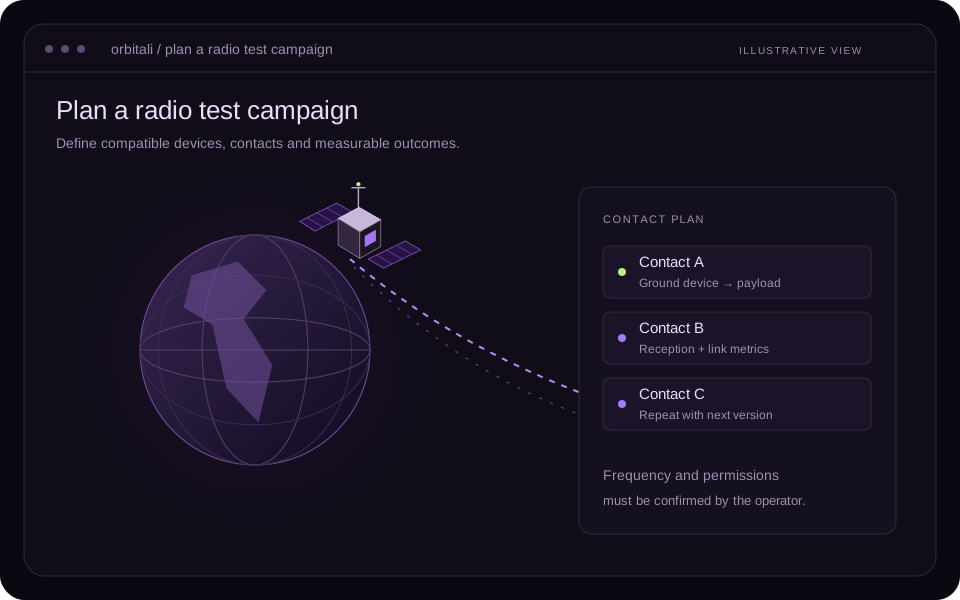
An example brief, not a customer quotation.Compare receiver-side software versions across 20 agreed test contacts.
A compatible receive payload, approved contact opportunities and access to the required signal or packet logs.
Contact records, reception metrics and a version-by-version comparison.
A PLANNING COMPARISON
For this example, assume the following two routes to the same software test. The shared route depends on an existing payload being suitable.
You coordinate a dedicated spacecraft or payload, integration, launch access and operations. This route offers more control over hardware and mission design.
Your budget covers an assumed scope of integration, payload access, execution, data return and reporting. The existing operator retains spacecraft control.
They are not market benchmarks, operator quotes or measured customer savings. The dedicated route may cost more or take longer. The shared execution target starts only after compatibility checks, integration, operator approval and capacity confirmation; that preparation adds lead time. Actual scope, pricing and schedule must be agreed before a real mission.
BEFORE YOU BOOK
YOUR BOOKING PLAN
Only the interfaces approved for this experiment.
A requested number of suitable passes with compatible ground devices.
Agreed reception logs, timestamps and performance metrics.
FROM BRIEF TO RESULTS
Document frequency, waveform, device compatibility and required permissions.
Confirm geometry, scheduling and the experiment scope with the operator.
Collect consistent measurements for the two software versions.
Evaluate reception behaviour and the conditions under which each result was obtained.
An existing radio payload can help when the experiment fits its frequency range, antenna and approved interfaces. That compatibility is the starting point.
This scenario is receive-side testing. It is not a general IoT connectivity service or a promise of bidirectional access. Transmission, spectrum permissions and additional payload capabilities require a separate scope.